





Let's talk straight

1. why the direct wording?

2. The Problem with ChatGPT, Gemini, and Others?

3. fake reviews and misleading advertising

Re 1: Why the direct wording?

Patients in Germany believe they are protected by government agencies and regulatory bodies. In the world of private healthcare, this is a fatal misconception. And because there is no oversight, people are misled and lied to left and right.

By now, we could write entire books about how the reputation of this procedure and the medical profession is being damaged by unscrupulous doctors, without the patient even realizing it. This is a serious issue, because it concerns their health.

Most doctors who offer this surgery have never been trained in it. It is not part of the training curriculum for a board-certified plastic surgeon. You have  often have no experience with this and produce poor results—if any results come out of it at all.

Just recently, a court ruling prohibited a doctor from claiming that he had performed 10,000 penis enlargements. 

A court ruling also prohibited a doctor from claiming that he had several hundred reviews regarding penis enlargement.

Another doctor was ordered by a court ruling not to claim that he performs 500 penis enlargements per year.

The Darmstadt Regional Court was the most explicit on this point: it convicted a plastic surgeon who had posed as an expert in penis enlargement, stating that the defendant had failed to prove that he had ever independently performed even a single penis enlargement surgery in his life.

Unfortunately, however, none of these court rulings resulted from the intervention of a government agency or a medical association. Rather, they came about simply because other doctors were vigilant and took the cases to court at their own expense.

Re 2: The problem with ChatGPT, Gemini, and the like?

Patients trust these artificial intelligence systems, mistakenly believing that they are truly intelligent and capable of assessing facts. They are not. After all, they are not human journalists who are bound by a journalistic code of ethics. When it comes to health issues, this can have catastrophic consequences for patients.

ChatGPT, for example, claimed—of all things—that this doctor was prohibited from claiming he had performed 10,000 surgeries or that he had special expertise in penis enlargement, precisely because of that figure of 10,000 on his website.

In another case, ChatGPT praised a specialized plastic surgery clinic for its expertise in penis enlargement. In reality, this clinic does not exist at all. The doctor had merely claimed on his website that he ran a specialized clinic. Probably because he knew that ChatGPT doesn’t verify such claims at all, but simply accepts them as true and even issues a recommendation.

Gemini, for example, recommends a doctor as an expert in penis enlargement who not only fabricated significant parts of his training but also performs unapproved therapies on patients—in other words, human experiments—for his own financial gain, and even described him as “innovative.”

Generally speaking, these systems “hallucinate,” as the technical term goes. For example, when AI claims that it obtained its information from guidelines issued by medical professional associations, that is simply false. After all, it cannot access that information at all. Only when the user directly tells the machine not to lie to them does it admit it.
Before that, it makes it seem as if it can do it. Why? Because the developers make billions from users asking these machines questions—but not from users stopping asking them because the answers are obviously wrong.

Re 3: Social Media and Patient Reviews

Social media is a hotbed of paid misinformation and self-proclaimed experts. This is especially true when posts come across as particularly professional. Because “professional” means they cost a lot of money. They’re advertisements—nothing else.

And based on our experience over the past 30 years, we find it hard to imagine that any patient would willingly allow himself to be filmed during his penis enlargement surgery without, in return, having the procedure performed completely free of charge and signing an agreement stating that he may not discuss side effects or poor results.

Regarding reviews, here’s a reminder of what we already published in the FAQ section on patient testimonials, as it highlights the problem: A doctor in the Rhine-Main region who performs penis enlargements had over 1,400 fake reviews—which he had posted across various platforms—deleted after other doctors brought the issue to light.
And in the case of another doctor who claimed to have more than 500 patient reviews regarding penis enlargement, the court found that there was in fact only one review—not 500.

AI and social media have been the subject of massive hype, especially over the past two years. We hope that patients will increasingly find their way back to using their common sense more often, because the reality is that even users who believe they can distinguish truth from lies are, in fact, not quite able to do so yet. It’s also complex, and the world hasn’t become any simpler as a result.

UGRS

Advice & appointments:
Monday – Friday
9.30 am – 7 pm

We regularly ask our patients (anonymously!) about their satisfaction with penis enlargement surgery for internal quality assurance purposes. Previously carried out by external service providers, we now carry out these surveys ourselves so that any problems can be addressed much more effectively.

The last survey (evaluation 11/ 2024), which we conducted using self-designed questionnaires – which are much more useful for us in terms of gaining knowledge than questionnaires formulated by external companies that only have a superficial knowledge of penis enlargement -, carried out about three months after the operation, revealed the following with regard to the 4 main factors:

Satisfaction with on-site support before the operation: 4.9

Professional competence of doctors and staff: 5

Satisfaction with the result: 4.8

Satisfaction with care after the operation: 5

(choice of quality levels 1-5; 50 patients participated randomly and sent in their questionnaires anonymously)

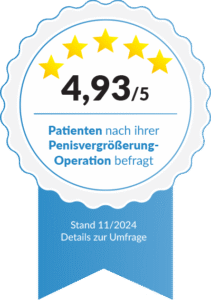
Result: 4.93 out of 5.0

UGRS

Advice & appointments:
Monday – Friday
9.30 am – 7 pm

UGRS

Advice & appointments:
Monday – Friday
9.30 am – 7 pm

We regularly ask our patients (anonymously!) about their satisfaction with penis enlargement surgery for internal quality assurance purposes. Previously carried out by external service providers, we now carry out these surveys ourselves so that any problems can be addressed much more effectively.

The last survey (evaluation 11/ 2024), which we conducted using self-designed questionnaires – which are much more useful for us in terms of gaining knowledge than questionnaires formulated by external companies that only have a superficial knowledge of penis enlargement -, carried out about three months after the operation, revealed the following with regard to the 4 main factors:

Satisfaction with on-site support before the operation: 4.9

Professional competence of doctors and staff: 5

Satisfaction with the result: 4.8

Satisfaction with care after the operation: 5

(choice of quality levels 1-5; 50 patients participated randomly and sent in their questionnaires anonymously)

Result: 4.93 out of 5.0